
Real Estate Due Diligence in Québec: Understanding OACIQ Requirements
Real estate due diligence in Québec involves more than reviewing a property listing. Ownership records, registered rights, municipal information, environmental data and historical documents can all contribute to a clearer understanding of a property.
For real estate brokers, gathering and reviewing this information forms part of a broader professional framework established by Québec regulations and the Organisme d’autoréglementation du courtage immobilier du Québec (OACIQ).
But while professional judgment remains essential, the process of finding, organizing and documenting property information can involve navigating numerous independent sources.
That’s where having the right tools can make a meaningful difference.
This guide explores the OACIQ’s published framework, the property information relevant to due diligence, and how modern tools like le topo can support a more organized and efficient approach to property research.
By le topo · Updated
In short
- Real estate due diligence goes beyond the listing. Property ownership, registered rights, municipal records, environmental information and historical documents can all provide relevant context.
- The OACIQ establishes the professional framework. Québec real estate brokers have responsibilities involving verification, information, advice and documentation.
- Property information comes from multiple sources. Accessing and organizing those sources can be a substantial part of preparing a property file.
- Clear documentation matters. Keeping source references and supporting documents organized makes information easier to revisit, compare and trace.
- Tools like le topo can simplify the process. By bringing available property information, source documents and a structured report together, le topo helps brokers approach their research with a clearer starting point.
What is real estate due diligence in Québec?
Real estate due diligence refers broadly to the process of gathering, reviewing and understanding relevant information about a property before or during a real estate transaction.
A property’s characteristics are not always apparent from its listing or physical appearance. Important information may be found in public registers, municipal documents, government maps, historical records and other sources.
For example, property research may reveal information concerning:
- Ownership and registered rights
- Servitudes and other published charges
- Cadastral identification and lot characteristics
- Municipal assessment and taxes
- Zoning and permitted uses
- Flood zones and other environmental considerations
- Seller’s declarations and available historical records
Each source provides a different part of the property’s overall picture. A municipal assessment roll, for example, does not serve the same purpose as the Québec Land Register, and neither replaces the information contained in a certificate of location.
Understanding a property therefore involves more than finding documents. It also means knowing where the information comes from, reviewing it in context, and identifying where additional clarification may be needed.
For real estate brokers, this research takes place within the professional framework established by Québec real estate brokerage regulations and the OACIQ’s published guidelines.
What does the OACIQ say about real estate broker due diligence?
The OACIQ is the organization responsible for overseeing real estate brokerage in Québec and protecting the public within its mandate.
Its guideline, “Verification, Information and Advice”, explains the professional duties of real estate brokers concerning the verification of information, the communication of relevant facts, advice and documentation. The guideline presents these duties as carried out together throughout the brokerage mandate and the transaction.
Verification of information
Section 5 of the Regulation respecting brokerage requirements, professional conduct of brokers and advertising addresses the verification of information provided to the public or to another licence holder.
The OACIQ’s guideline expands on this duty: it emphasizes checking the accuracy of information against reliable, up-to-date sources and being able to document where that information came from. This is why official records, supporting documents and identifiable sources play a central role in real estate due diligence.
Information and advice
The Regulation also addresses the duties of brokers concerning information, objectivity, factors that may adversely affect a transaction, and recourse to qualified experts when appropriate. These subjects are notably covered in sections 80, 81, 83, 84 and 85.
The guideline describes how informing the parties of relevant factors and advising clients build on the information gathered and verified. How these provisions apply to a given mandate is a matter of professional judgment for licensed brokers and, ultimately, for the competent regulatory authorities.
For questions specific to brokers representing a buyer, see our guide to buyer’s broker checks before the Promise to Purchase.
Documentation and traceability
The guideline makes documentation part of the professional process itself. It describes recording the steps taken, the verifications made, the information disclosed and the advice given, so that the file is complete, up to date and well organized.
Property information can originate from many documents consulted at different moments. Preserving source references, the documents themselves and a record of the work performed makes that information easier to retrieve, compare and explain later.
Official references: OACIQ, Verification, Information and Advice guideline and LégisQuébec, Regulation C-73.2, r. 1. These remain the authoritative sources for the official professional requirements.
Taken together, these principles highlight why property research is not simply about finding individual facts. The information also needs to be examined, supported by identifiable sources, and organized in a way that allows the broker to revisit and document the relevant steps.
This is where the way property information is collected and presented can make a practical difference in a broker’s workflow.
The OACIQ’s framework: verification, information, advice and documentation
In its guideline, the OACIQ presents the broker’s professional approach as six connected stages, from understanding the client’s needs to documenting the steps taken:
- UnderstandingThe client’s needs and mandate
- VerifyingVerifying and validating the information
- AnalyzingRisks and specific features
- InformingThe client and the parties concerned
- AdvisingAdvising and guiding clients
- DocumentingDocumenting and adjusting continuously
Source: OACIQ guideline “Verification, Information and Advice”, section 2.
The stages are not isolated tasks. Information gathered at the verification stage feeds the analysis, shapes what the broker communicates and advises, and is recorded as the file is documented and updated.
le topo illustration, not an OACIQ diagram
Where organized property information supports the process
Most directly supported
| Stage | Practical support |
|---|---|
| Understanding | Establishing the property and transaction context |
| Verifying | Access to source information and supporting records |
| Analyzing | Structured information to review and compare |
| Informing | Clear information to consult when preparing communications |
| Advising | Professional judgment remains with the broker |
| Documenting | Organized reports and available source documents |
The stage names and their order come from the OACIQ. Read the OACIQ’s six-stage professional approach for the key questions the guideline sets out at each stage.
What property information is relevant to due diligence?
Property due diligence in Québec can involve several sources of information. Understanding what each source contains helps explain why real estate research often extends beyond a single document.
Different sources of Québec property information
- Land RegisterPublished rights and registered acts
- CadastreLot number and boundaries
- MunicipalityAssessment, taxes and zoning
- Environmental dataFlood zones and other constraints
- Seller’s declarationsWhat the seller declares about the property
- Certificate of locationA land surveyor’s professional document
A fuller picture of the property
Québec Land Register and Index of Immovables
The Registre foncier du Québec (Québec Land Register) is a key source of published real estate rights.
Its Index of Immovables (Index des immeubles) provides access to references to acts registered against a particular lot, which may include transfers of ownership, hypothecs, servitudes and other published rights.
These records provide information about a property’s legal history. As the Québec government notes, reading the Index is not always sufficient: interpreting the legal effect of an act may require a qualified professional.
Cadastre and municipal assessment roll
The Québec cadastre identifies lots and represents their cadastral boundaries.
Municipal assessment rolls provide administrative information used for property assessment and taxation, including certain property characteristics and assessment values.
These sources serve different purposes. A cadastral plan, a municipal assessment record and a certificate of location should not be treated as interchangeable documents.
Municipal zoning and property-use information
Municipalities publish regulations and information concerning land use, zoning and development.
Depending on the municipality, some information may be accessible through online maps, zoning grids, planning documents or municipal services.
The availability and format of these sources vary between municipalities, and the interpretation of applicable rules may require confirmation by the relevant authority or professional.
Environmental information and flood zones
Government and municipal resources can provide information about certain environmental characteristics and constraints.
Examples include official flood-zone mapping, the contaminated land register (Répertoire des terrains contaminés) and other geographic information.
An important distinction is that the absence of an entry in a particular database does not necessarily establish the absence of an environmental risk.
These sources are useful pieces of information, but their coverage, dates and limitations must be considered. For more on this topic, see our guide to flood zones in Québec.
Seller’s declarations and property history
The Declarations by the Seller of the Immovable (DV), previous description sheets and other available historical records may contain information about a property’s condition and past events.
Historical information can provide additional context, particularly when different documents describe a property’s characteristics or history over time.
The reliability, completeness and availability of these records can vary. See also our guide to seller declarations and brokerage contracts.
Certificate of location
A certificate of location, prepared by a land surveyor, provides information about the property’s situation in relation to property titles, the cadastre and applicable laws and regulations.
It is a distinct professional document, and no online property summary or automated report takes its place.
For a more detailed explanation of the subjects identified by the OACIQ, see our guide to the 12 main real estate broker verification areas and where to find property information.
These sources illustrate why property research can quickly become a multi-document process. Each record serves a distinct purpose, and the information may be spread across different government portals, municipal services and supporting documents.
Having relevant information organized in one place can make it easier to navigate those sources, understand what is available, and identify the documents that may require further examination.
Why organized property information matters in real estate due diligence
Property information in Québec is spread across multiple independent systems. The Land Register, municipal assessment records, cadastral information, environmental maps and property documents each provide different pieces of information.
Finding those records is one part of the work. Organizing them into a coherent property file is another.
When documents and references are scattered across different sources, it can be more difficult to review information together, revisit previous findings, and keep track of the material collected.
Fragmented information. Records are maintained by different organizations and often accessed through separate platforms.
Different purposes. Each source answers different questions about the property.
Changing information. Records may be updated at different times, making dates and source context relevant.
Information requiring examination. A document may contain information that calls for additional review or professional interpretation.
Traceability. Being able to return to the underlying source makes the information easier to verify and document.
The more information a property file brings together, the more valuable clear organization becomes.
A well-structured dossier doesn’t replace the broker’s expertise. It gives that expertise a more practical foundation to work from.
How technology can simplify property research and documentation
Traditionally, researching a property can involve moving between several registries, municipal websites, government maps and individual documents.
Modern property information platforms can simplify part of that process by gathering information from the sources they cover and presenting it in a more organized format.
Rather than beginning with an empty folder and a series of separate searches, the broker can start with a structured overview of the information available for the property. Depending on the platform and its coverage, that can mean:
A clearer starting point
Available property information is brought together instead of being scattered across separate searches.
Easier access to supporting documents
Source references and available documents can be consulted alongside the information presented.
More structured review
Organizing information by subject makes it easier to navigate the property file and examine relevant details.
Better visibility into information gaps
Where the platform supports it, missing information and points requiring attention can be clearly identified.
More straightforward documentation
Structured reports and source documents can help brokers organize the material supporting their own work.
Technology and professional expertise: complementary roles
None of this changes who does the professional work. It changes what the broker starts from. In le topo’s case, the division looks like this:
What le topo helps organize
- Available property information
- Source references
- Supporting documents
- Structured findings
- A professional report
What the broker brings
- Knowledge of the client’s circumstances
- Professional judgment
- Interpretation of relevant information
- Follow-up and additional verification
- Information and advice to clients
How le topo organizes property information around the broker’s workflow
Rigorous property research involves more than accessing individual records. Brokers need to navigate different sources, review the information they contain, and keep relevant documents organized throughout their work.
le topo was designed around this reality.
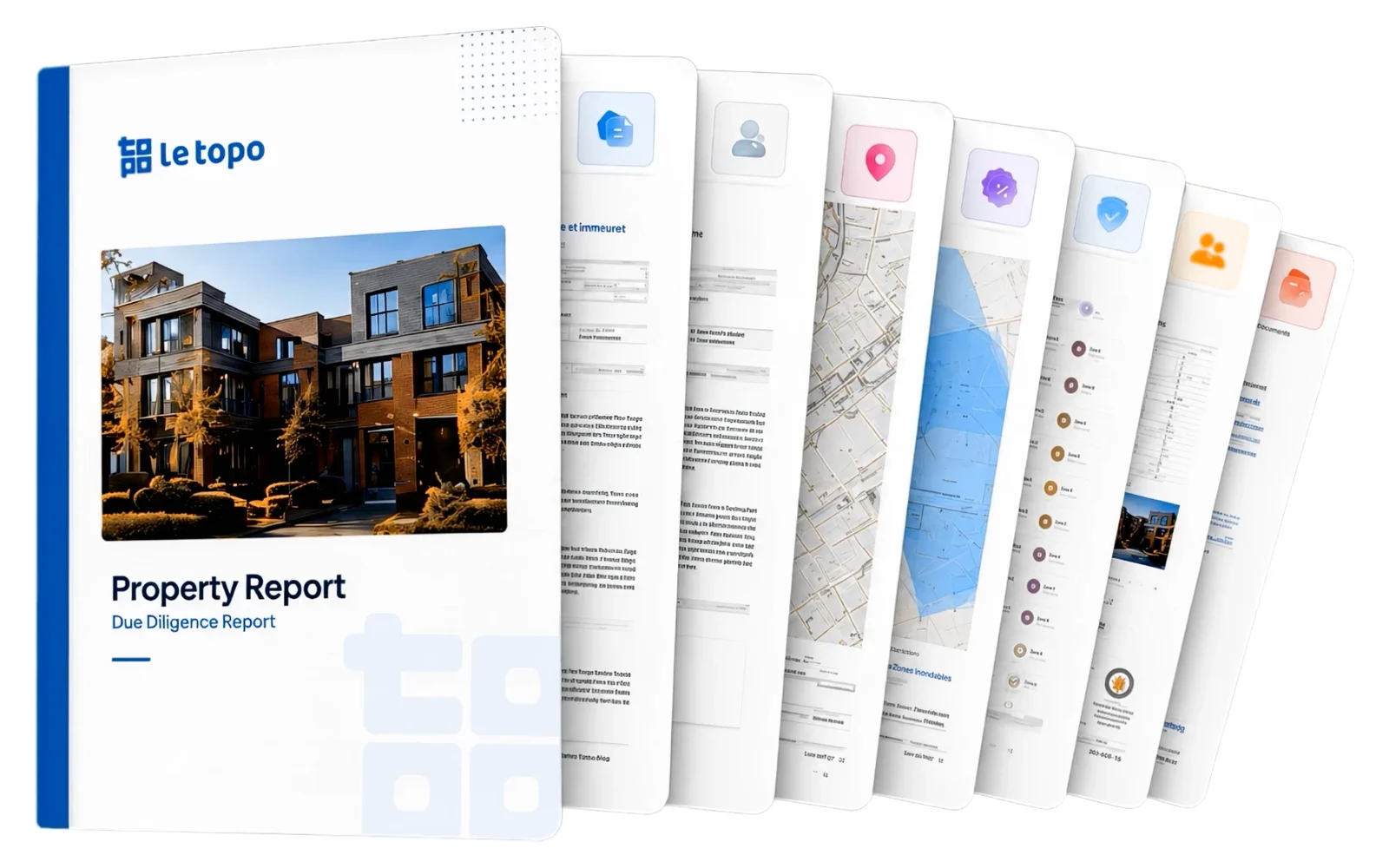
Built for Québec real estate brokers, le topo brings available property information and source documents together from a single property address, presenting the results in a structured dashboard and a professional PDF report.
Instead of working through a collection of disconnected sources, brokers can begin with a clearer overview of the property and the information available for review.
The platform organizes information by subject, identifies certain points that may require further attention, and indicates when information could not be retrieved.
The result is a more organized starting point for property research, with the supporting documents and references available for consultation.
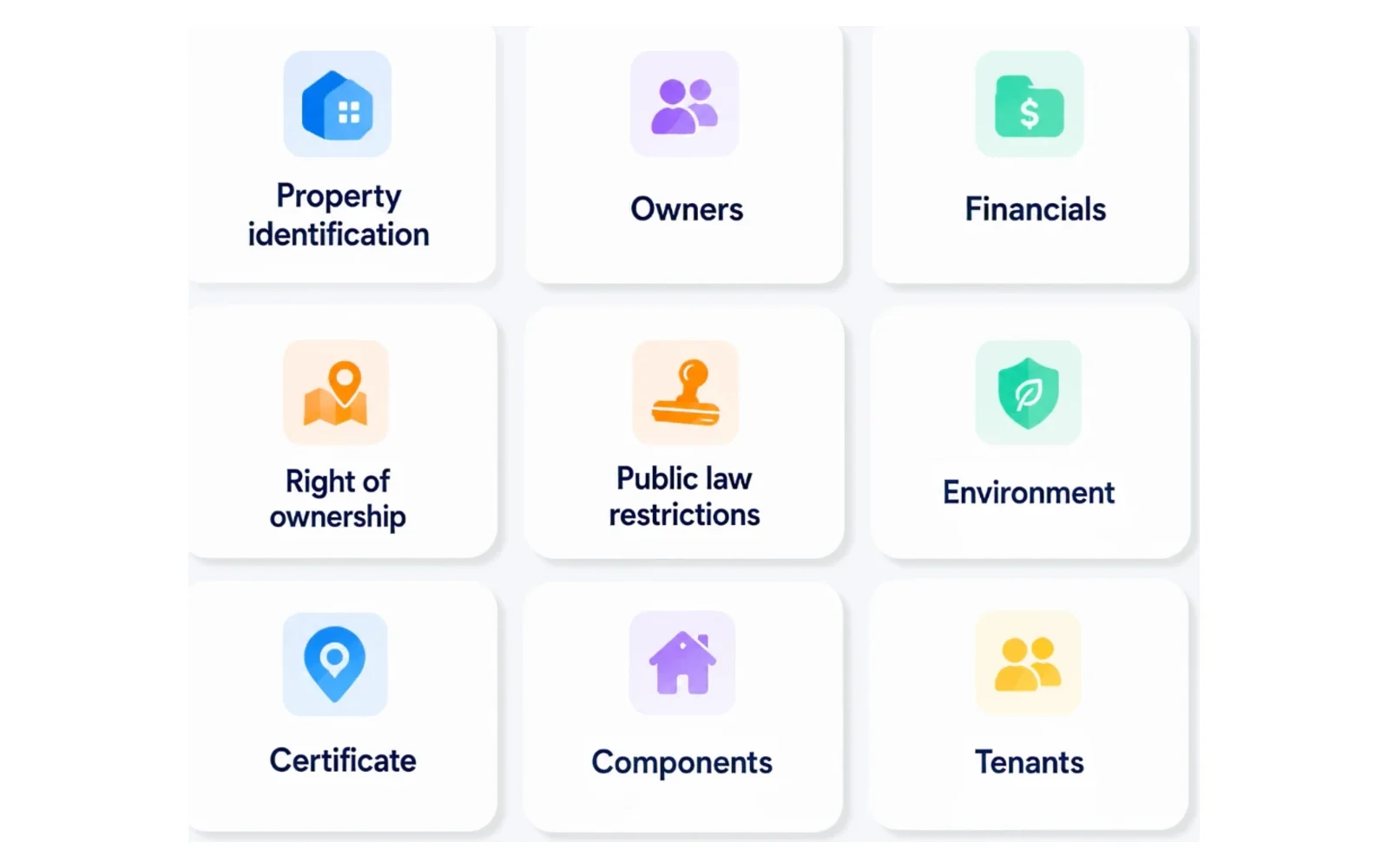
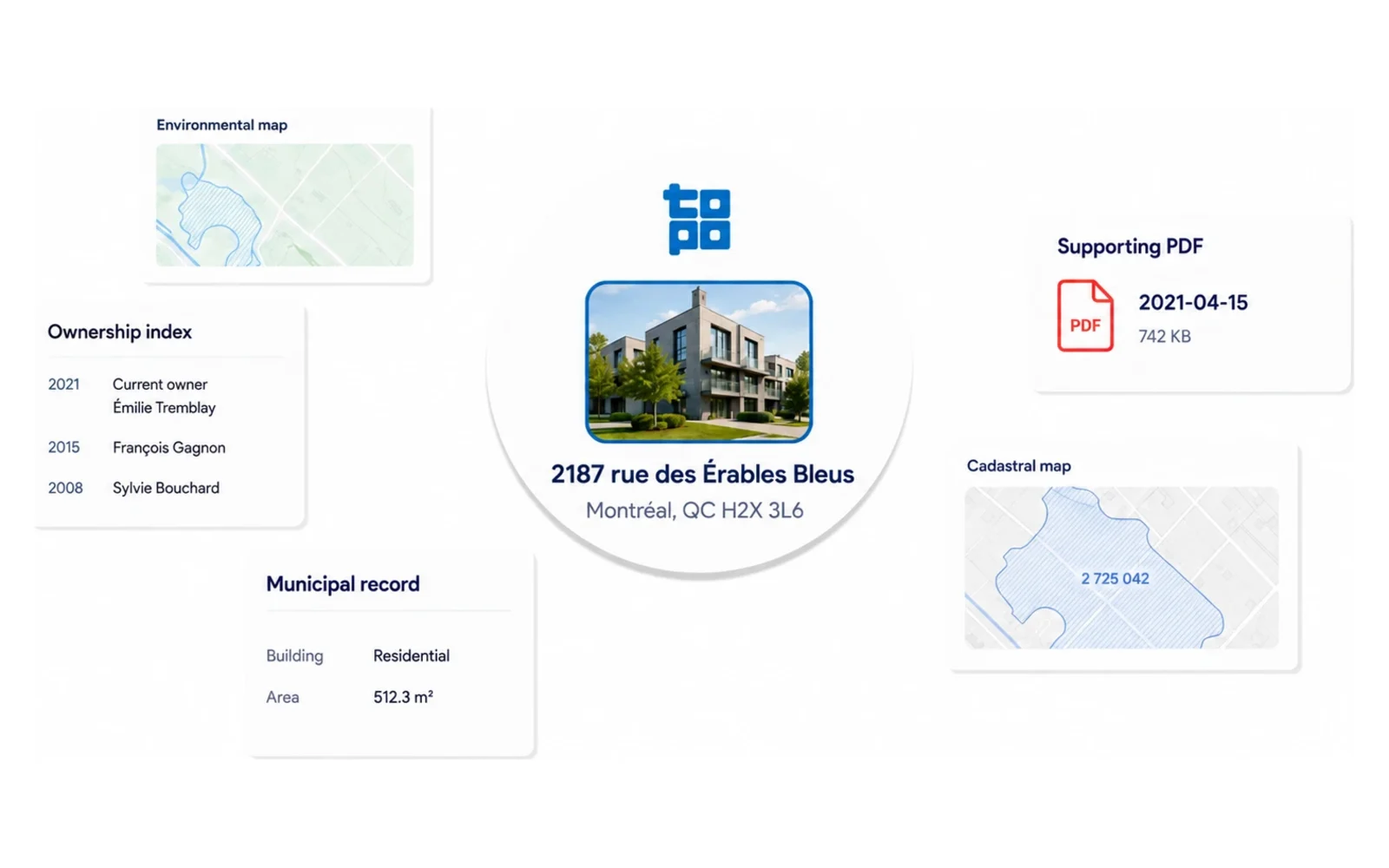
At a glance
- Designed for Québec real estate brokers
- Reserved for licensed brokers, whose licences are validated with the OACIQ, and authorized members of their team
- Single-family homes and residential plexes of 2 to 5 units, anywhere in Québec
- Available in French and English
- A property dashboard, source documents and a PDF report for each property
- Information retrieved from the sources the platform covers, when available; each report names the sources consulted
See a sample report, section by section.
As with any property research tool, the information available depends on source coverage and accessibility. Brokers remain responsible for examining the findings and determining any additional steps appropriate to their work.
A practical example: bringing property information together
Fictional example
When two records show different land areas
A broker is preparing the file for a single-family home. The municipal assessment roll and the cadastral information do not show the same area for the land.
- Assessment roll: land area
- 465.2 m²
- Cadastre: lot area
- 452.8 m²
A difference to examine
Why it can happen
The two records serve different purposes and are not updated at the same time. A difference can have several explanations, such as a recent cadastral operation or an assessment unit that includes more than one lot, and neither record settles the question on its own.
With le topoDone by: le topo
When this information is available in the sources covered, the assessment details and the cadastral information appear in the same property dossier, with the available source documents, such as the municipal record and the cadastral plan, alongside.
The broker’s reviewDone by: You
Review the records, consider whether the difference matters for the mandate, and determine whether further clarification is needed.
The benefit is not that software makes the professional decision. It is that organized information can make the review process easier to approach.
Frequently asked questions
What is real estate due diligence in Québec?
Real estate due diligence is the process of gathering and reviewing relevant information about a property, including ownership records, registered rights, municipal information, environmental data and historical documents. For real estate brokers, it takes place within the professional framework established by Québec regulations and the OACIQ.
What is the OACIQ’s role in real estate due diligence?
The OACIQ oversees real estate brokerage in Québec and publishes professional guidelines. Its “Verification, Information and Advice” guideline addresses the broker’s duties to verify information, inform the parties, advise clients and document the steps taken, and is an official reference for licensed brokers.
Why is documentation important in Québec real estate due diligence?
Documentation keeps a clear record of the information consulted, its sources and the steps taken during the professional process. The OACIQ’s published guidance addresses documentation as part of the broker’s broader responsibilities involving verification, information and advice.
What documents are relevant to property due diligence in Québec?
Depending on the property, relevant documents may include extracts from the Québec Land Register and its Index of Immovables, registered deeds, cadastral information, the municipal assessment roll, the certificate of location, the seller’s declarations, applicable municipal information and government environmental records.
Is real estate due diligence the same as a home inspection?
No. Real estate due diligence can involve documentary, legal, administrative and environmental information. A building inspection is a separate professional service focused on aspects of a building’s physical condition. One does not replace the other.
Can property information be found online in Québec?
Yes. Several sources are available online, including the Québec Land Register, municipal assessment services and certain government mapping portals. Availability, access conditions and fees vary by source.
Can an automated report replace a real estate broker’s due diligence?
No. An automated platform can gather and organize available information, but the licensed broker’s professional judgment and responsibilities remain. Some matters may also call for a notary, a land surveyor, a building inspector or another qualified professional.
How does le topo help with property information research?
le topo helps Québec real estate brokers bring available property information and source documents together from a single address. The platform presents the results in a structured dashboard and a professional PDF report, making it easier to navigate the available information, review findings and organize supporting documentation. The broker remains responsible for professional interpretation and any additional verification required.
Sources
- OACIQ – Guideline: Verification, Information and Advice
- OACIQ – Guideline, section 1: The fundamentals of real estate brokerage practice
- OACIQ – Guideline, section 2: The professional approach of the real estate broker
- LégisQuébec – Regulation respecting brokerage requirements, professional conduct of brokers and advertising (C-73.2, r. 1)
- Gouvernement du Québec – Registre foncier (in French)
- Gouvernement du Québec – Property history and the Index des immeubles (in French)
- Gouvernement du Québec – Cadastre (in French)
- Gouvernement du Québec – Property assessment (in French)
- Gouvernement du Québec – Flood zone mapping (in French)
- Ministère de l’Environnement – Répertoire des terrains contaminés (in French)