
Before the Promise to Purchase: Property Information for Québec Buyer's Brokers
A property can look promising from its listing, photographs, and first visit. But the information relevant to a buyer's decision often extends well beyond what is immediately visible.
Ownership records, registered rights, municipal information, environmental characteristics, the property's history, and seller-provided documents can all contribute to understanding an immovable.
For a Québec buyer's broker, this information is considered in the context of the client's project and the professional framework established by the OACIQ.
Before a Promise to Purchase is prepared, having relevant property information accessible and organized can make the review process clearer and more focused.
This guide explores the types of property information involved, the documents that may provide useful context, and how structured research can support the broker's work before an offer.
By le topo · Updated
In short
- A property listing is only one source of information. Registered rights, municipal records, environmental information, historical documents, and seller declarations may provide additional context.
- The buyer's project matters. The relevance of different property characteristics depends on the client's objectives and circumstances.
- The OACIQ establishes the professional framework. Its guidance addresses the buyer's broker's responsibilities concerning verification, information, advice, and protection of the client's interests.
- The Promise to Purchase contains different provisions and conditions. Their application depends on the transaction and the relevant official forms.
- A more organized starting point. le topo helps bring available property records and source documents together to support the broker's review.
The buyer's broker's role: understanding the client and the property
In section 4.2 of its guideline Verification, Information and Advice, the OACIQ describes the buyer's broker as the person who guides the client and protects their interests. It groups the buyer's broker's main obligations into three related areas.
Understanding the buyer's project
The guideline begins with the client's project and profile: their needs, objectives, constraints, and knowledge, along with the factors that may influence their decision, such as values, concerns, a specific project, or budget. It also refers to carrying out the necessary checks, particularly when there is doubt about the information received.
Examining property information
The second area concerns the information about the property. The guideline refers to examining the description sheet, the Declarations by the seller of the immovable (the DS form, or DSD for divided co-ownership) and the related documents, obtaining available documents such as invoices and previous inspection reports, and explaining the transaction documents so that clients understand their scope.
Listing information and public records are different kinds of sources. The description sheet and the seller's declarations present the property as described for the sale. Section 1.1 of the same guideline names other reliable sources, such as the Land Register, municipal information, the certificate of location, and environmental registers, and speaks of sources appropriate to the type of property and the client's project.
Supporting informed decisions
The third area concerns the client's interests in the Promise to Purchase. The OACIQ describes it in terms of recommending appropriate protective measures, such as inspections, conditions, additional verifications, or legal advice, and assisting clients so that they can make a free and informed decision. How these considerations apply to a particular offer depends on the circumstances of the transaction.
These expectations rest on the Regulation respecting brokerage requirements, professional conduct of brokers and advertising. The guideline links the duty to inform to sections 83 and 85, the duty to advise to section 80, and the discovery of factors that may affect the parties or the transaction to section 84. Our guide to real estate due diligence in Québec looks at that framework as a whole.
These responsibilities illustrate why the buyer's project and the property information available need to be considered together.
Two buyers may be interested in the same property for very different reasons. The relevance of particular property characteristics can therefore depend on their respective objectives.
How buyer priorities can differ for the same property
The OACIQ's guideline speaks of adapting the scope of verifications to the nature of the property, its context, and any risk indicators. Put another way, the information that deserves the closest reading is not necessarily the same for every buyer.
The three fictional examples below show how a buyer's objectives can bring different kinds of property information forward. They describe the information, not the conclusions: whether a project is possible is a question for the municipality, the appropriate professionals, and the broker's own examination.
How different buyer projects bring different information forward
Fictional examples
- Example AA buyer considering renovationsThe buyer hopes to extend the house or substantially modify it after the purchase.Information that may come into focus
- Zoning and municipal by-laws
- Permits and municipal records
- Cadastre and certificate of location
What do the municipal rules and the lot's documented boundaries say about the space around the building?
- Example BA buyer considering a plexThe buyer is looking at a property with several dwellings, to live in one unit or to rent them all.Information that may come into focus
- Permits and municipal records
- Property characteristics
- Leases and occupancy documents
How do the municipal records and the available documents describe the building and its current use?
- Example CA buyer drawn to a waterfront propertyThe buyer is interested in a house on a lake or river, for its setting and its access to the water.Information that may come into focus
- Zoning and municipal by-laws
- Cadastre and certificate of location
- Flood-zone and shoreline mapping
- Registered rights and restrictions
What do the official maps and the property's documents show about the lot's position near the water?
The waterfront example is a reminder that flood mapping has its own vocabulary and its own limits. Our guide to flood zones in Québec explains how to read it.
Property information that may matter before an offer
Behind every listing sits information held by different organizations and recorded in different documents. None of it replaces the visit or the inspection; each kind adds context the others do not.
Information behind a listing that can add context
The listing
The description sheet, the photographs, and the first visit: the property as it is presented for sale.
Behind it
- Seller-provided recordsWhat the seller declares and documents about the property, including what no public register holds.Seller's declarationsInvoicesPrevious inspection reports
- Published rightsWho owns the property and which rights and charges are published against the lot.Land RegisterRegistered deeds
- Municipal informationHow the municipality describes, assesses, and regulates the property.Zoning by-lawAssessment rollPermits
- Property characteristicsThe lot, the building, and their dimensions as recorded in official documents.CadastreCertificate of locationAssessment roll
- Environmental contextWhat government maps and registers show about the property's surroundings.Flood-zone mappingContaminated land register
- Historical documentationEarlier transactions and documents that show how the property has changed over time.Previous deedsEarlier certificatesPrevious description sheets
A simplified illustration, not an exhaustive list of sources. Which layers are relevant, and what they contain, depends on the property.
The five groups below describe what these sources contain. Our guide to the 12 main verification areas goes into each one in more depth.
1. Ownership and registered rights
The Québec Land Register's Index of Immovables lists the deeds and rights published against a lot: transfers of ownership, hypothecs, servitudes, and notices such as a declaration of family residence or a notice of contamination. The registered deeds set out the terms of those rights. The OACIQ's page on consulting the online Land Register (in French) describes how the register is used to identify limitations on the right of ownership.
For a buyer, these records show who is selling, what the property is charged with, and which rights others may hold over it. The legal effect of a particular right, such as the scope of a servitude, is a matter for the appropriate professionals, such as a notary.
2. Property use and municipal context
Zoning by-laws, adopted by each municipality, set the uses permitted in each zone, and permits and other authorizations record what has been approved for a particular building. Section 6.5 of the OACIQ's guideline lists zoning, servitudes, and restrictions of use among the factors that may limit a property's intended use.
This is where the buyer's intentions matter most. An extension, a change of use, or a home business can make municipal information central to the examination. Properties in Québec's agricultural zone are also subject to the agricultural land protection regime administered by the Commission de protection du territoire agricole du Québec (CPTAQ). Whether a given use is permitted is a question for the municipality and, where relevant, the other authorities involved.
3. Environmental and geographic information
Government maps and registers add geographic context, such as the flood-zone map and the register of contaminated land (in French), which the Environment ministry notes is not exhaustive. Municipalities and regional county municipalities (RCMs) may hold further information through their land use planning documents and by-laws. Section 7 of the OACIQ's guideline addresses flood zones as a specific context.
4. Assessment, taxes, and property characteristics
The municipal assessment roll (in French) gives the values entered for the land and the building, along with descriptive data such as the lot area, the year of construction, and the number of dwellings. An assessed value is not a market value. Municipal and school taxes appear on their respective tax bills, and how they can be consulted varies from one municipality to another.
Transfer duties, often called the welcome tax, are a separate, transaction-related consideration. In the OACIQ's residential Promise to Purchase, the buyer undertakes to pay them; they are calculated by the municipality on the basis of the transfer.
5. Seller declarations, history, and supporting documents
The seller's declarations add information that public records do not hold, such as past water damage or work carried out, and are often accompanied by invoices, permits, or notices. According to the OACIQ's page on building inspection (in French), the existence of a previous inspection report is declared on the DS form, and the seller provides the report to the buyer on request. Seller-provided information and public records describe the property from different vantage points: one does not replace the other. Our guide to seller declarations and brokerage contracts looks at these documents from the listing side.
The certificate of location, prepared by a land surveyor, describes the property's situation in relation to its titles, the cadastre, and certain applicable rules. Under the OACIQ's residential Promise to Purchase, the seller undertakes to provide one describing the current state of the immovable, which the OACIQ explains covers both its physical and its legal state; it notes, for instance, that a change in zoning such as a new flood zone calls for a new certificate. See the OACIQ on the importance of an up-to-date certificate, and our guide to inspections, certificates of location, and broker checks for what it covers.
How the Promise to Purchase addresses different transaction considerations
In Québec, the Promise to Purchase is a formal transaction document that addresses the buyer's proposed terms and the conditions applicable to the offer.
The OACIQ's official forms contain provisions concerning subjects such as financing, inspection, document review, and other declarations or conditions.
The relevance and wording of particular provisions depend on the transaction and are matters for the licensed professionals involved.
According to the OACIQ's buyer's guide, there are mandatory Promise to Purchase forms for different kinds of property, including chiefly residential immovables of fewer than five dwellings (excluding co-ownership), divided and undivided co-ownership, and mobile homes on leased land. For new construction bought from a builder, the Civil Code calls for a preliminary contract instead. The forms' provisions and their numbering differ, so the overview below stays at the level of subjects.
What the official form addresses
Simplified overview
Promise to Purchase · OACIQ mandatory form
- Financing
- Terms concerning a proposed new hypothecary loan, and the period for the buyer to show it has been obtained.
- Inspection
- Whether the promise is conditional on an inspection by a person chosen by the buyer, and the period in which it takes place.
- Document review
- Documents the buyer wishes to review, such as leases or equipment rental contracts, and the period for the seller to provide them.
- Declarations of the parties
- Each party's declarations and obligations, including the seller's undertakings on titles and the certificate of location.
- Other declarations and conditions
- Additional terms relevant to the particular transaction.
- Annexes
- Additional OACIQ forms that become part of the promise where applicable, such as the seller's declarations, financing, an expert report, or drinking water and septic systems.
The OACIQ's explanation of the Promise to Purchase describes each clause and links to the forms themselves, and its practice guide covers, for example, the buyer's declarations and obligations. They are the authoritative references for anything beyond this overview.
The role of the building inspection
A building inspection addresses aspects of the property's physical condition that documentary research alone cannot establish.
Section 81 of the Regulation respecting brokerage requirements, professional conduct of brokers and advertising requires brokers to recommend a full inspection by a professional or a building inspector who meets the prescribed criteria. According to the OACIQ's page on building inspection and the broker's responsibilities (in French), those criteria are professional liability insurance, a recognized inspection service agreement, a recognized standard of practice, and a written report. The same page notes that a pre-sale inspection obtained by the seller does not relieve the broker of the obligation to recommend a pre-purchase inspection to the buyer.
This distinction matters because property documents, official registers, and a building inspection provide different types of information.
For how the work is divided between the inspector, the land surveyor, and the broker, see our guide to inspections and certificates of location.
Why keeping property information organized matters
Property research can involve documents gathered at different points in time and from different sources.
Land registry excerpts, municipal information, maps, seller-provided documents, and other records may each contribute useful context.
Keeping the source of each piece of information identifiable makes the material easier to revisit, compare, and understand.
The OACIQ's published guidance also addresses the importance of documenting professional verifications, information, and advice (guideline, section 1.4).
A well-organized property dossier provides a more practical foundation for reviewing available information throughout the transaction.
Getting a clearer picture of the property before making an offer
A property listing is only the starting point.
Behind it may be ownership records, registered rights, municipal assessments, environmental information, historical documents, and other sources relevant to understanding the immovable.
le topo was built to help Québec real estate brokers bring that information together.
Starting from a property address, the platform gathers available information from its covered sources and presents it in a structured dashboard, with source references, supporting documents, and a professional property report.
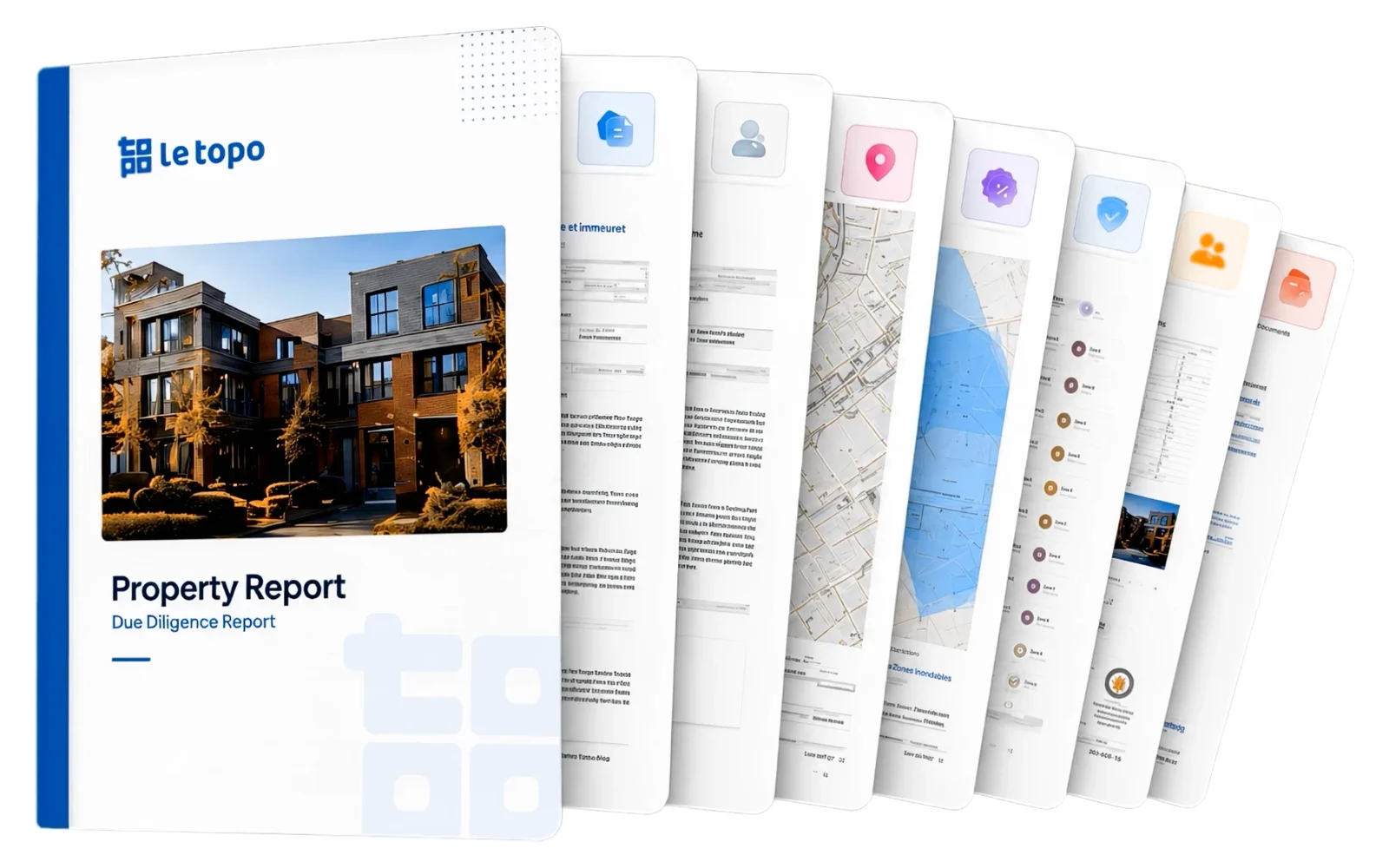
For a buyer's broker, this provides a practical starting point for reviewing the property's documented background alongside the listing and other available information. Depending on the property and source availability, the dossier can include the owners on record and the chain of title from the Index of Immovables, published hypothecs and servitudes, the cadastral lot and assessment roll data, municipal and school tax amounts, the municipality's transfer-duty rates, environmental map layers, the certificates of location referred to in registered deeds and, for rental properties, records of landlord–tenant matters associated with the property.
Instead of beginning with several disconnected searches, the broker can access an organized overview of the available findings and identify subjects that may warrant closer attention.
The report's risk panel sorts certain findings into general information, items to monitor, and items to verify, and the report indicates when information was not available. See a sample le topo report. le topo currently covers single-family homes and residential plexes of 2 to 5 units across Québec.
The expertise behind the decision belongs to the broker. le topo helps make the information behind the property easier to access and review. Available information depends on the property and source coverage, and the broker remains responsible for examining the findings and determining the appropriate follow-up.
Frequently asked questions
What does the OACIQ say about the buyer's broker's responsibilities?
Section 4.2 of the OACIQ's guideline Verification, Information and Advice describes the buyer's broker as guiding the client and protecting their interests, in three areas: understanding the client's project and profile; examining the description sheet, the seller's declarations, and related documents, and explaining the transaction documents; and protecting the client's interests in the Promise to Purchase, including recommending appropriate protective measures and helping the client make a free and informed decision.
What property information may be relevant before a Promise to Purchase?
Information about a property can come from the Land Register (owners, hypothecs, servitudes, and other published rights), the municipality (zoning, permits, assessment, and taxes), government environmental maps and registers, the certificate of location, and the seller's declarations with their supporting documents. Which of these matter most depends on the property, the transaction, and the buyer's project.
Does a buyer's broker have to recommend a building inspection?
Yes. Section 81 of the Regulation respecting brokerage requirements, professional conduct of brokers and advertising requires brokers to recommend a full inspection by a professional or a building inspector who meets the prescribed criteria: professional liability insurance, a recognized service agreement, a recognized standard of practice, and a written report. The OACIQ notes that the Promise to Purchase form also allows the buyer to waive the inspection, and stresses understanding the implications of that decision.
What does the certificate of location tell a buyer?
Prepared by a land surveyor, the certificate of location describes the property's situation in relation to its titles, the cadastre, and certain applicable rules, and may report servitudes or encroachments. It reflects the property as it was when the surveyor made the findings. Under the OACIQ's residential Promise to Purchase, the seller undertakes to provide a certificate describing the current state of the immovable, physical and legal.
What if a property document is not available before an offer?
The OACIQ's Promise to Purchase forms include a provision for the review of documents by the buyer, along with other conditions and annexes, and their appropriate use depends on the transaction. For one document in particular, the OACIQ's buyer's guide states that if the Declarations by the seller of the immovable are not available when the promise is signed, the broker makes obtaining them a condition of the offer.
How can le topo support a buyer's broker before an offer?
le topo brings available property information from covered sources into a structured dashboard and report. This helps Québec real estate brokers review relevant records, access supporting information, and approach property research with a more organized starting point before a potential offer.
Sources
- OACIQ – Guideline, section 4: Roles and responsibilities of real estate brokers
- OACIQ – Guideline, section 1: The fundamentals of real estate brokerage practice
- OACIQ – Guideline, section 6: Information about the property, main verifications and adverse factors
- OACIQ – Guideline, section 7: Specific contexts (co-ownership, new constructions and flood zones)
- OACIQ – Buyer's guide: the Promise to Purchase
- OACIQ – Declarations and obligations of the buyer (PP)
- OACIQ – Building inspection and the real estate broker's responsibilities (in French)
- OACIQ – Importance of an up-to-date certificate of location
- OACIQ – Verifying limitations on the right of ownership and consulting the online Land Register (in French)
- LégisQuébec – Regulation respecting brokerage requirements, professional conduct of brokers and advertising (CQLR, c. C-73.2, r. 1)
- Government of Québec – Land Register
- Government of Québec – Property assessment (in French)
- Government of Québec – Check whether a property is in a flood zone
- Ministère de l'Environnement – Register of contaminated land (in French)