
Manual vs. automated real estate due diligence in Québec
Real estate due diligence depends on rigorous research, reliable sources and good documentation. But do you still need to check every register separately, download documents one by one and rebuild a property's file yourself?
Today, tools like le topo can significantly simplify that collection and organization work. Property information comes together in a structured dashboard, alongside its source documents and a professional report.
This guide compares manual and automated methods, how they differ, and how a platform built for Québec real estate brokers can support a more efficient, better-documented practice.
By le topo · Updated
In short
- Manual research means checking several sources separately, retrieving the documents and pulling the information together to build the file.
- Automated due diligence simplifies that collection by bringing information from several sources into one structured workspace.
- With le topo, brokers get a dashboard, the available source documents and a professional report in their name, so they can approach their verifications with the full picture.
- The broker's expertise remains essential: the tool makes the file easier to prepare and document, while the professional remains responsible for their analysis, follow-ups and advice.
Manual due diligence: how does the research work?
Researching a property by hand means going through several sources one at a time. Which ones depends on the property and the transaction, but the list often includes:
- the Québec land register (Registre foncier) and cadastre, for the index of immovables, published deeds and lot details;
- the municipality, for the property assessment roll, tax bills, zoning and permits;
- government maps showing flood zones, landslide-prone areas, contaminated land and agricultural zoning;
- documents attached to the listing, such as the Declarations by the seller of the immovable;
- for a plex or a company-owned property, rental records and the enterprise register.
Each source has its own access rules. To search the index of immovables, for example, you need the lot number and a client account, and there's a consultation fee, according to the Québec government (in French). The OACIQ's Verification, Information and Advice guideline lists the questions to ask, the main sources to check and the documents to keep on file for each topic. For an overview of these verifications, see also our guide to real estate due diligence in Québec.
This method lets you tailor your research to each property. But it also means moving between several registers, finding the relevant information, downloading documents and organizing them into a coherent file.
A large share of the work is collecting and organizing information, before you can even review the findings and decide what follow-up is needed. That is exactly where an automated due diligence platform can make a difference.
- Done by: You
Identify the property and its lot number.
- Done by: You
Check each relevant source separately.
- Done by: You
Download documents and note where each came from.
- Done by: You
Pull the findings together and list follow-up questions.
How automated due diligence reduces scattered research
Automated due diligence changes how property research begins. Instead of starting from several registers, municipal websites and scattered documents, the broker can start from a structured view of the information available on a property.
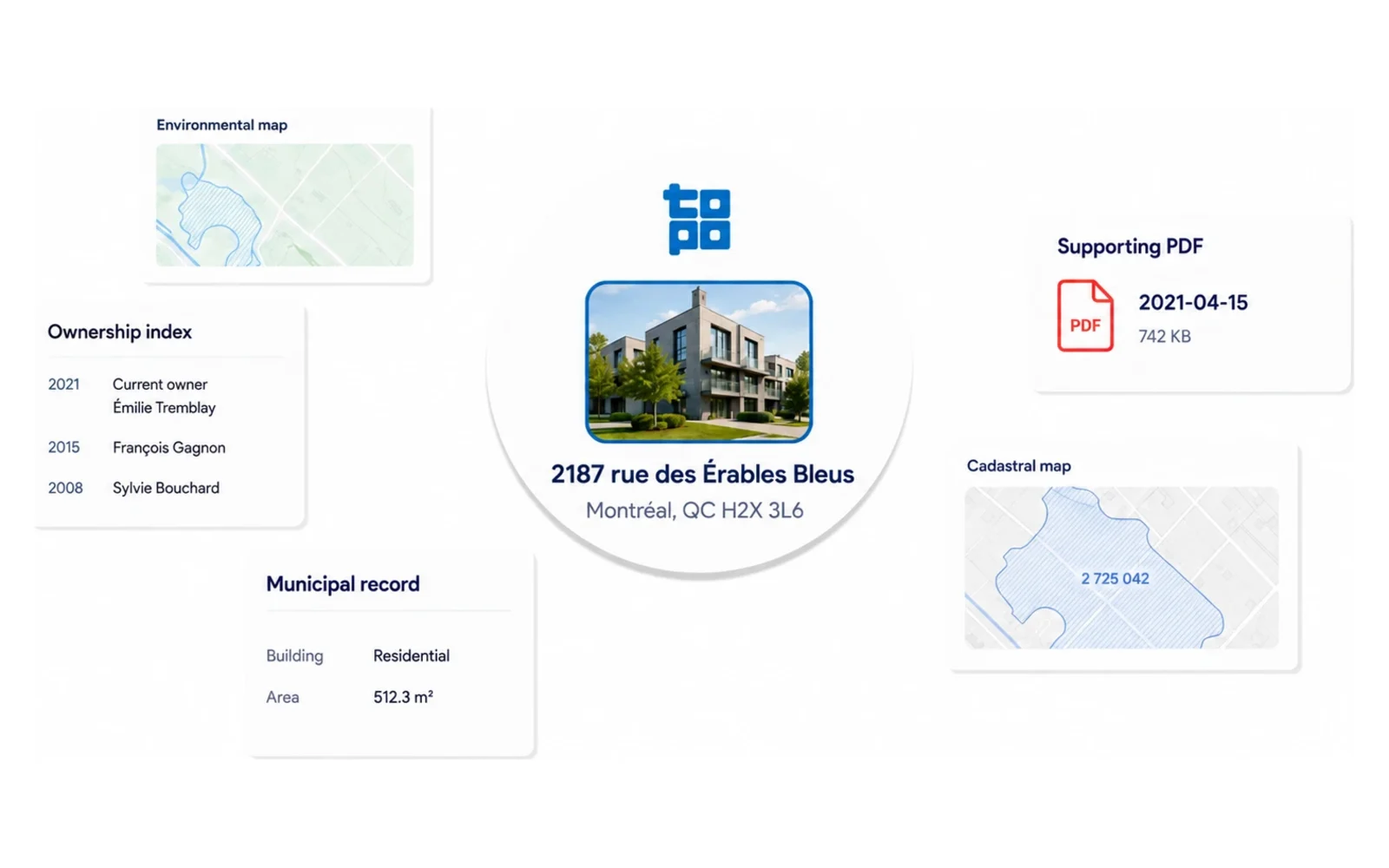
That's the approach behind le topo, a platform built specifically for Québec real estate brokers. From an address, the platform gathers information from the sources it covers, organizes it by topic and pairs it with the available documents. The broker gets a documented starting point to review the property, spot what deserves attention and carry on with their verifications.
The goal isn't to do the verifications for the broker, but to spare them from starting from scratch on every file.
Structured information for more focused verifications
Beyond centralizing information, le topo highlights points that may need particular attention and identifies information that couldn't be retrieved. The broker can more easily tell what's available from what still needs a closer look, and direct their further research accordingly.
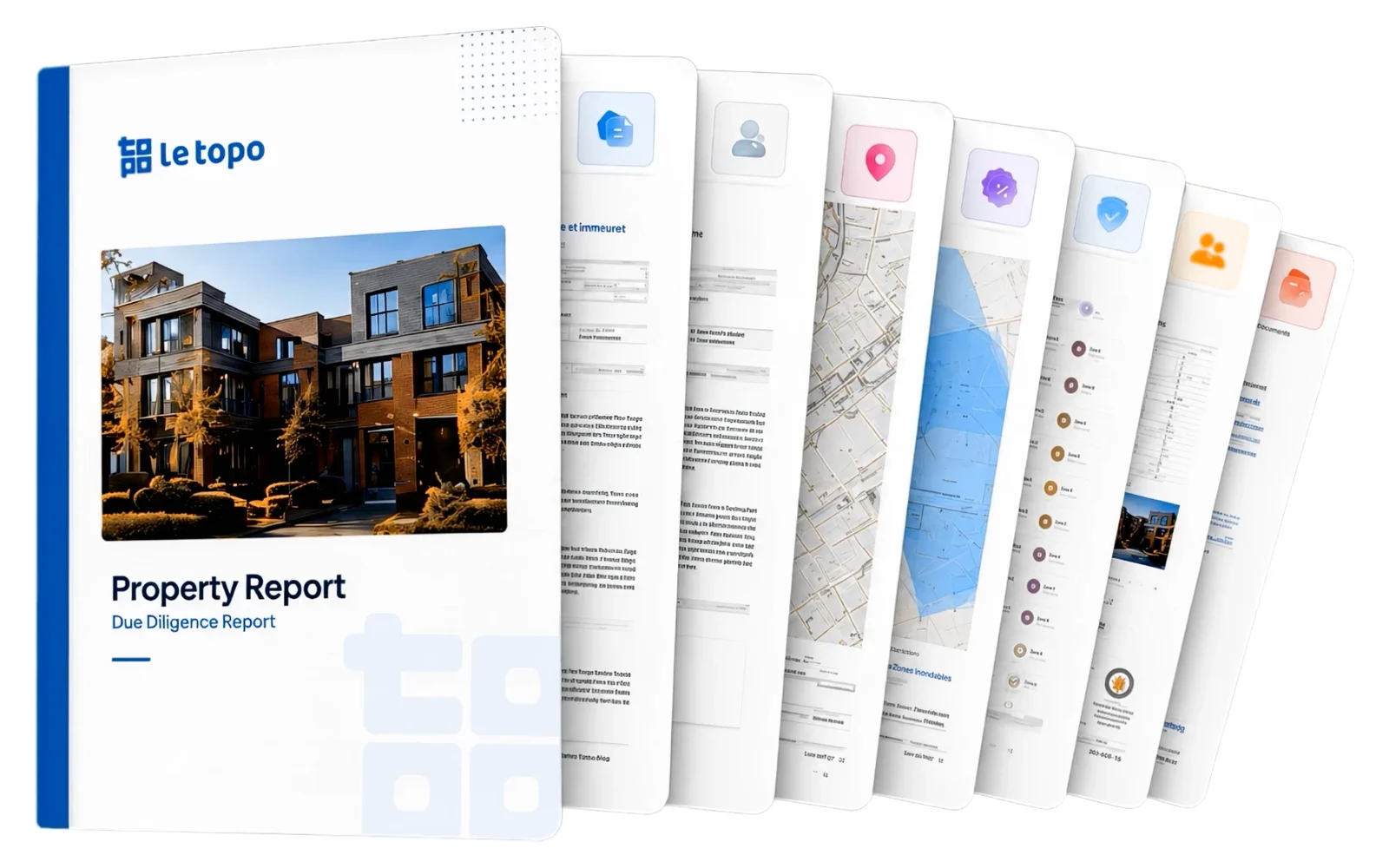
As with any document research, results are reviewed in context and supplemented according to the property's particulars. To go further, see a sample report, section by section.
- Done by: You
Enter the property address.
- Done by: le topo
Gather information from the sources it covers.
- Done by: You
Review the dashboard, source documents and report, then decide what to check next.
Manual vs. automated real estate due diligence: what changes?
The difference lies mainly in how information is gathered, organized and documented. Here's what that changes in practice when preparing a file.
| Aspect | Manual research | With le topo |
|---|---|---|
| Starting point | Several websites and registers to check one by one | One address to start collecting from the sources covered |
| Overview | Information to gather and compare | Information grouped in a structured dashboard |
| Source documents | Documents to find, download and file | Retrieved documents kept together with the file |
| Points to review | Items to spot as the research goes along | Points of attention and missing information highlighted |
| Preparing the file | Manual organization and compilation | Professional report in your name, ready to review |
| Further follow-up | Based on the research results | Based on the report's results and the file's particulars |
| Broker's expertise | Essential | Essential |
OACIQ verification obligations: where does automation fit in?
The OACIQ describes the real estate broker's professional approach as six connected steps: understand, verify, analyze, inform, advise and document (guideline, section 2). These verification obligations apply whatever tool you use. A platform like le topo comes in where information needs to be gathered, organized and kept, so the broker can spend their time on analysis and advice.
- Understand
Identify the client's needs
- Verify
Sources gathered and documented
- Analyze
Findings structured for review
- Inform
Organized information to consult
- Advise
Exercise professional judgment
- Document
Report and supporting documents
The broker remains responsible for every step. The highlighted steps show the activities le topo can support.
Practical example: two sources, information that doesn't match
Fictional example
When the listing and the assessment roll show different unit counts
Imagine a property presented as a triplex in its listing, while the municipal assessment roll shows two units.
- Listing
- 3 units
- Municipal assessment roll
- 2 units
A difference to review
With manual research
The broker checks this information separately, then has to gather the documents and compare them to notice the difference.
With le topoDone by: le topo
When this information is available in the sources covered, le topo brings it together in one file and flags the difference as a point to review.
The next step is yoursDone by: You
Look into the situation, check with the relevant sources and document the steps taken.
The platform flags the information; what you do with it is up to your professional judgment. The value of a tool like this is making information more accessible and structured, so you can give more attention to your review and the follow-up it calls for.
How to choose a real estate due diligence platform in Québec
Not every solution offers the same sources, the same level of documentation or the same working experience. For a real estate broker, a platform's value goes beyond retrieving data. It also lies in how easily that data can be consulted, understood, traced back to its sources and added to the file.
Those are the needs le topo was built around: bringing property information together, organizing it clearly and providing a professional report with the available documents. Here are the key criteria to consider when choosing a tool for your practice.
1. Relevant sources for Québec properties
Due diligence in Québec relies on Québec-specific sources: the land register and index of immovables, the Québec cadastre, the property assessment roll, municipal and school tax bills, and environmental data. A useful tool covers these sources, states which property types it handles and shows where each piece of information comes from.
The le topo platform currently covers single-family homes and plexes of 2 to 5 units across Québec. The sources it checks are named in the report.
2. A structured reading of the property, beyond a list of data
Collecting information only solves part of the problem. You also need to be able to navigate it, understand it and quickly spot what needs review. A long list of raw data leaves all the organizing to the broker.
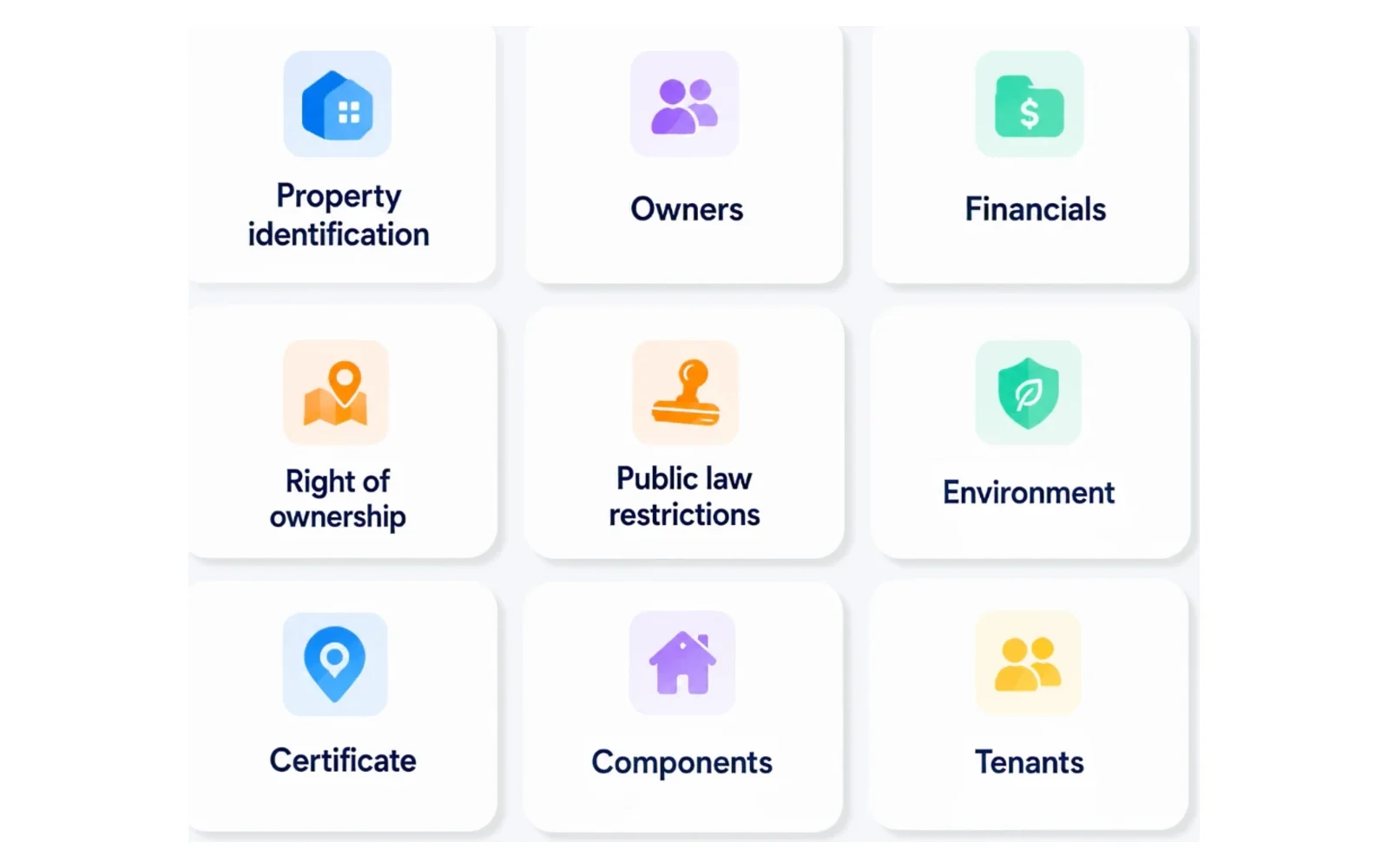
In le topo, the dashboard groups information by topic: property identification, owners, financials, right of ownership, public law restrictions, environment, certificate of location, components and tenants. Points of attention and missing information are highlighted, so you can move from one topic to the next without losing track of the file.
3. Documents to back up the findings
To document a file, knowing what a source says isn't enough: you need to be able to find the source itself. Supporting documents let you check a piece of information, put it in context and keep it on file.
With le topo, retrieved source documents, such as the index of immovables, the cadastral plan, the municipal record or an environmental map, are kept with the property's file. Their availability varies by property and source.
4. A professional report that makes the file easier to prepare
A well-structured report makes it easier to review the file, keep a record of the verifications done and communicate with the client.
The PDF report produced by le topo is presented in your name and organized by section. It names its sources, shows what couldn't be found and highlights points to check. You can share it with your client when you see fit and save it to your document management system along with the source documents. See a sample report, section by section.
Practical information
| Topic | What to know |
|---|---|
| Properties covered | Single-family homes and plexes of 2 to 5 units, anywhere in Québec. |
| Price | $95 per report, or $900 for a bundle of 10 reports ($90 per report). Special rates may apply to partner agencies. |
| Turnaround | Most reports are generated within minutes, depending on the property and the availability of source information. |
| Languages | Available in French and English. |
| Consulting and sharing | Findings reviewed in the dashboard; report and source documents to share with your client or save to your document management system. |
| Access | Reserved for Québec real estate brokers, whose licence is validated with the OACIQ, and authorized members of their team. |
What automation doesn't replace
A due diligence platform is a research and documentation tool. It helps gather and organize the available information, but it doesn't replace professional expertise or the specific checks a transaction may require:
- the professional review of the information, which remains the broker's responsibility;
- the further research or clarification some situations call for;
- the pre-purchase inspection, which looks at the condition of the building;
- the certificate of location, which only a land surveyor can prepare;
- the follow-up specific to each property and each transaction.
Source coverage and availability can also vary. Servitudes and encroachments, for instance, show up on the certificate of location prepared by a land surveyor (in French) and in the published deeds. For flood zones, the government's interactive map is for information only; the municipality or MRC confirms the official boundaries (Québec government, in French). Our guides to flood zones in Québec and the broker verification checklist go into more detail.
That's precisely the value of automation: simplifying part of the preparatory work so the broker can focus more attention on reviewing the findings and the follow-up steps.
Frequently asked questions
Does an automated due diligence report meet my OACIQ verification obligations?
Not on its own. An automated report supports verifying and documenting information, but analyzing the findings, following up and advising your client remain the broker's responsibility. It gives you an organized, documented basis for carrying out those obligations.
If a report finds nothing on a topic, does that mean there's no issue?
Not necessarily. An empty result can come down to what the sources contain or the scope of the search. That's why le topo shows which information couldn't be retrieved: you know where to focus your further checks and can note the steps you took in the file.
Can I use manual research and an automated platform together?
Yes. It's actually a practical way to organize your research. A platform like le topo lets you start with grouped, documented information, then complete your verifications based on the property's particulars and what you've found.
Does automated due diligence replace a pre-purchase inspection or a certificate of location?
No. Automated due diligence is document research. A pre-purchase inspection looks at the condition of the building, and only a land surveyor can prepare a certificate of location. These steps complement each other.
Sources
- OACIQ – Guideline: Verification, Information and Advice, section 2: The professional approach of the real estate broker
- OACIQ – Guideline: Verification, Information and Advice, section 3: The main verifications of the real estate broker
- Gouvernement du Québec – Historique d'une propriété (index of immovables, lot number, fees; in French)
- Gouvernement du Québec – Cartographies des zones inondables en vigueur (flood zone maps in force; in French)
- Ordre des arpenteurs-géomètres du Québec – Certificat de localisation (in French)