
Before Publishing a Centris Listing: Property Information and Supporting Sources
A property description sheet brings together many details: lot dimensions, municipal assessment, taxes, building characteristics, permitted uses, and more.
Once a listing is published in Centris, that information becomes accessible to other real estate professionals and, through public-facing listings, prospective buyers.
Behind those fields are different sources of information. The Québec Land Register, cadastre, municipal records, certificate of location, and other property documents each contribute different details.
Bringing those details together is one part of preparing a listing. Understanding where they come from is another.
This guide is not a tutorial on entering data in the Centris software. It explores the main categories of property information found in a Centris description sheet, the documents associated with them, and how a more organized approach can support listing preparation.
By le topo · Updated
In short
- A Centris listing brings together information from multiple sources. Property identification, dimensions, assessment, taxes, rights, and other characteristics may rely on different documents.
- Source reliability matters. The OACIQ's guidance addresses the accuracy, verification, and documentation of information included in property description sheets.
- Different records serve different purposes. A municipal assessment roll, cadastral plan, registered deed, and certificate of location are not interchangeable sources.
- Property information can evolve. New documents and information may affect how a property is described during the listing period.
- A more organized starting point. le topo brings available information from covered sources into a structured property dossier, helping brokers review supporting information before publication.
How a property file becomes a public listing
Before publication, property information may exist across several documents and systems. Once entered into a description sheet, those details become part of how the property is presented to other real estate professionals and prospective buyers.
The description sheet brings information together into a format designed to communicate the property's characteristics.
That makes the relationship between the published fields and their underlying sources particularly important.
The OACIQ's published guidance addresses the accuracy, reliability, and documentation of the information brokers provide or allow to be provided during their professional activities.
Centris's role
Centris describes its system as a collaboration network between real estate brokers. According to Centris (in French), only brokers can list a property in it; once listed, the property is offered to brokers across Québec and their buyer clients, and published on Centris.ca. Centris also consolidates and disseminates real estate data on behalf of brokers who are members of a real estate board or association.
The broker-facing system and the public site do not necessarily show the same things. The OACIQ notes, for example, that previous seller's declarations and description sheets are accessible to brokers who are members of a real estate board, while Centris.ca presents the listing to the public. The step where a listing is entered, often called Saisie à la source in French, is where the file's information takes on that shared form.
How property information reaches a listing
- 1. Property informationDetails held in different records and documents, brought together in the broker's file.
- Cadastre
- Municipal assessment
- Land Register
- Certificate of location
- Other property documents
- 2. Description sheetThe information is organized into one structured description of the property, with the statements it must include.
- 3. Published listingOnce entered in Centris, the listing is shared with real estate professionals and presented to the public.
- Real estate professionals
- Brokers working in the Centris system
- Prospective buyers
- The public listing on Centris.ca
A simplified illustration of where listing information comes from and where it goes. What each audience can see depends on the listing system and the information involved; this is not a depiction of the Centris software.
What the OACIQ says about listing information
In its guideline Verification, Information and Advice (section 6.1), the OACIQ describes the description sheet as often the first source of information consulted by the public and by brokers. The guidance on listing information rests on a few principles:
- Accuracy: the information in the description sheet must be accurate, verified, and up to date.
- Verification using reliable information: information from the seller, previous documents, or third parties is validated using reliable sources.
- Supporting documentation: the information is consistent with the documents in the file, and the records that demonstrate its accuracy are kept on file. The OACIQ also states that information the broker cannot verify or document should not be included in the description sheet.
- Clear descriptions: ambiguous or imprecise wording that may mislead a party is avoided.
- Updates: the description is updated when new relevant information is brought to the broker's attention.
The OACIQ's advertising guideline treats the description sheet as an advertising tool that must contain accurate, verified information and reflect the reality of the property. These principles rest on provisions of the Regulation respecting brokerage requirements, professional conduct of brokers and advertising.
Reference to official texts
Official references on listing information
| Official reference | Main subject |
|---|---|
| Regulation, s. 5 | Verifying the information provided to the public or to another licence holder, and always being able to demonstrate its accuracy |
| Regulation, s. 45 | Giving the represented party, without delay, a copy of any document containing the data used to describe the immovable |
| Regulation, s. 111 | Authorization for advertising or disseminating information about an immovable |
| Regulation, s. 112 | False, misleading, or incomplete representations and advertising, including the advertised selling price |
| Regulation, s. 118 | Statements required in a description sheet intended for the public, such as the existence of declarations by the owner |
| OACIQ guideline, s. 6.1 | Marketing information and description sheets: verification, reliable sources, consistency with the file, updates, and records |
The property information behind a Centris description sheet
Many fields in a property description sheet are connected to information held by different organizations or recorded in different documents.
Understanding which sources contain which types of information makes the description sheet easier to contextualize.
The examples below illustrate common information categories and the records associated with them. They are not an exhaustive list of listing requirements or a substitute for official OACIQ guidance. For the broader set of verification areas the OACIQ describes, see our guide to the 12 main verification areas.
Where the fields of a description sheet come from
Fictional illustration
Description sheet · fictional property
Lot number6 012 345
Associated records: Québec cadastre · Land RegisterCadastral designation of the lot
Land area418.6 m²
Associated records: Certificate of location · Cadastral planDimensions and area of the land
Municipal assessment$512,400
Associated records: Municipal assessment rollLand, building, and total values
Year built1962
Associated records: Assessment roll · Certificate of locationThe roll may mark a year as estimated
Registered rightsServitude of passage
Associated records: Land RegisterIndex of Immovables and registered deeds
Environmental contextOutside mapped flood zones
Associated records: Government mapsOfficial geographic data
Property identification and dimensions
Lot number and cadastral description. The lot number identifies the property in the Québec cadastre, and the Land Register's Index of Immovables records the deeds and rights published against that lot. For the summary description in the brokerage contract, the OACIQ refers to the Land Register, the seller's deed of acquisition, the certificate of location, and the cadastral plan. Because the cadastral renewal has assigned new lot numbers in many areas, an older deed may refer to a former designation.
Land dimensions and area. Dimensions and area describe the land, not the buildings on it. They are commonly documented in the certificate of location, the cadastral plan, or the description in the deed of acquisition, and the unit of measurement matters when figures from different documents are compared. In the context of the brokerage contract's summary description, the OACIQ advises against stating dimensions as "plus or minus" and suggests "irregular", with a reference to the certificate of location or the title, when an irregular lot cannot be described accurately.
Assessment and financial information
Municipal assessment. The property assessment roll (in French) gives the values entered for the land, the building, and the property as a whole, along with descriptive data used for assessment purposes. The OACIQ cites the current year's assessment roll as a supporting document for the property's value. An assessed value is not a market value.
Municipal and school taxes. Tax amounts come from the municipal and school tax bills, which the OACIQ lists, for the current year, as supporting documents for the taxes stated in a description sheet. How tax information can be consulted varies from one municipality to another.
Building characteristics
Year built. According to the ministry's description of the assessment roll (in French), the roll records the year the original construction of the main building was completed, regardless of later additions, and may note that the year is estimated or approximate. The certificate of location may also contain relevant information. Because each record has its own purpose and reference date, the years they show do not always match; the OACIQ cites both documents as supporting documents for the year of construction.
Number of dwellings. The assessment roll records the number of dwellings in the assessment unit, using its own definition of a dwelling. That figure describes the property for assessment purposes. It is distinct from what municipal zoning permits and from permits or other authorizations issued for the building, and when these sources describe the property differently, the difference may call for additional examination.
Rights and property restrictions
Servitudes and registered charges. Servitudes, hypothecs, and other real rights are published in the Land Register: the Index of Immovables lists the registrations affecting a lot, and the registered deeds set out their terms. The certificate of location may also report servitudes. The OACIQ notes that the Index of Immovables remains the source to use to identify owners, creditors, and the rights and restrictions affecting an immovable.
Zoning and permitted uses. Zoning by-laws and their schedules of permitted uses are adopted by the municipality, and permits, certificates, or other authorizations may provide context on a particular use. The OACIQ's guideline (section 6.5) lists zoning, servitudes, and restrictions of use among the factors that may limit a property's intended use.
Environmental information. Government maps and registers provide geographic context, such as the flood zone map and the register of contaminated land (in French), which the Environment ministry notes is not exhaustive. Our guide to flood zones in Québec explains how to read flood mapping.
Supporting documents
Certificate of location. Prepared by a land surveyor, the certificate of location sets out professional findings on the property's situation in relation to its titles, the cadastre, and certain applicable rules, and may report servitudes or encroachments. Its date matters: it reflects the property as it was when the surveyor made those findings, which is why the OACIQ stresses the importance of an up-to-date certificate. Our guide to inspections, certificates of location, and broker checks explains what it covers.
Seller's declarations and other property documents. The Declarations by the Seller and their supporting documents add information that public records do not hold. The OACIQ cites invoices, plans, estimates, and construction permits as supporting documents for renovations mentioned in a description sheet. Our guide to seller declarations and brokerage contracts looks at how these documents fit into preparing a listing.
Which sources support different listing details?
The reference below brings these associations together.
Listing information and the records commonly associated with it
| Listing information | Common documentary sources |
|---|---|
| Lot identification |
|
| Owner's identity |
|
| Land dimensions and area |
|
| Municipal assessment |
|
| Municipal and school taxes |
|
| Year built |
|
| Number of dwellings |
|
| Published rights |
|
| Zoning and permitted uses |
|
| Environmental context |
|
| Renovations and work |
|
| Property history |
|
Why accurate property descriptions matter beyond the numbers
Not every important detail in a listing is numerical. Descriptive terms, property characteristics, and remarks also contribute to how the immovable is presented.
The OACIQ's guidance emphasizes accuracy and clarity in marketing information, including avoiding descriptions that create a misleading impression. One of its own examples: a house requiring major repairs should not be described as "in excellent condition". Its guideline (section 6.5) also cautions against ambiguous statements such as "to be verified" when a reasonable course of action is possible.
Descriptions are also connected to other documents in the file. Under section 118 of the Regulation, a description sheet intended for the public mentions, where applicable, the existence of declarations by the owner and the availability of documents substantiating them, and the OACIQ's guideline describes the Declarations by the Seller as attached to the description sheet. The OACIQ also notes that the seller receives a copy of the description sheet, which allows them to review the published information.
Supporting records and seller-provided information may therefore offer useful context for understanding how a property is described.
Property information does not stop evolving after publication
A property description sheet reflects information available at a particular point in time.
During the listing period, new documents, inspection findings, or relevant facts may change the information available about the property.
The OACIQ's guidance addresses the need to keep marketing information accurate and to make appropriate updates when new relevant information arises.
This illustrates why source documentation matters beyond the initial preparation of a listing. It provides a record of the information underlying the property's description.
Seller's declarations, description sheet, and amendments
The OACIQ's guidance treats the seller's declarations and the description sheet as related but distinct documents. Changes to the declarations in the DS form are recorded on the mandatory Amendments (AM) form, signed by the seller and annexed to the DS form, according to the OACIQ's page on amending the seller's declarations. That page adds that when the description sheet mentions the seller's declarations, it should also indicate that they have been amended.
In the case described in section 6.1 of the guideline, a building inspection reveals a significant problem: the seller's broker sees that both the description sheet and the DS form are updated, with an AM form used to correct the seller's declarations. The description sheet itself is updated as information changes, and the AM form records changes to forms signed with the seller; the two are not interchangeable.
Before the listing goes live, bring the property information together
Preparing a description sheet involves information drawn from different sources: cadastral records, municipal assessments, property documents, registered rights, and more.
le topo was designed to make that information easier to access and organize for Québec real estate brokers.
Starting from a single property address, the platform gathers available information from its covered sources and presents the results in a structured dashboard, with supporting documents and a professional property report.
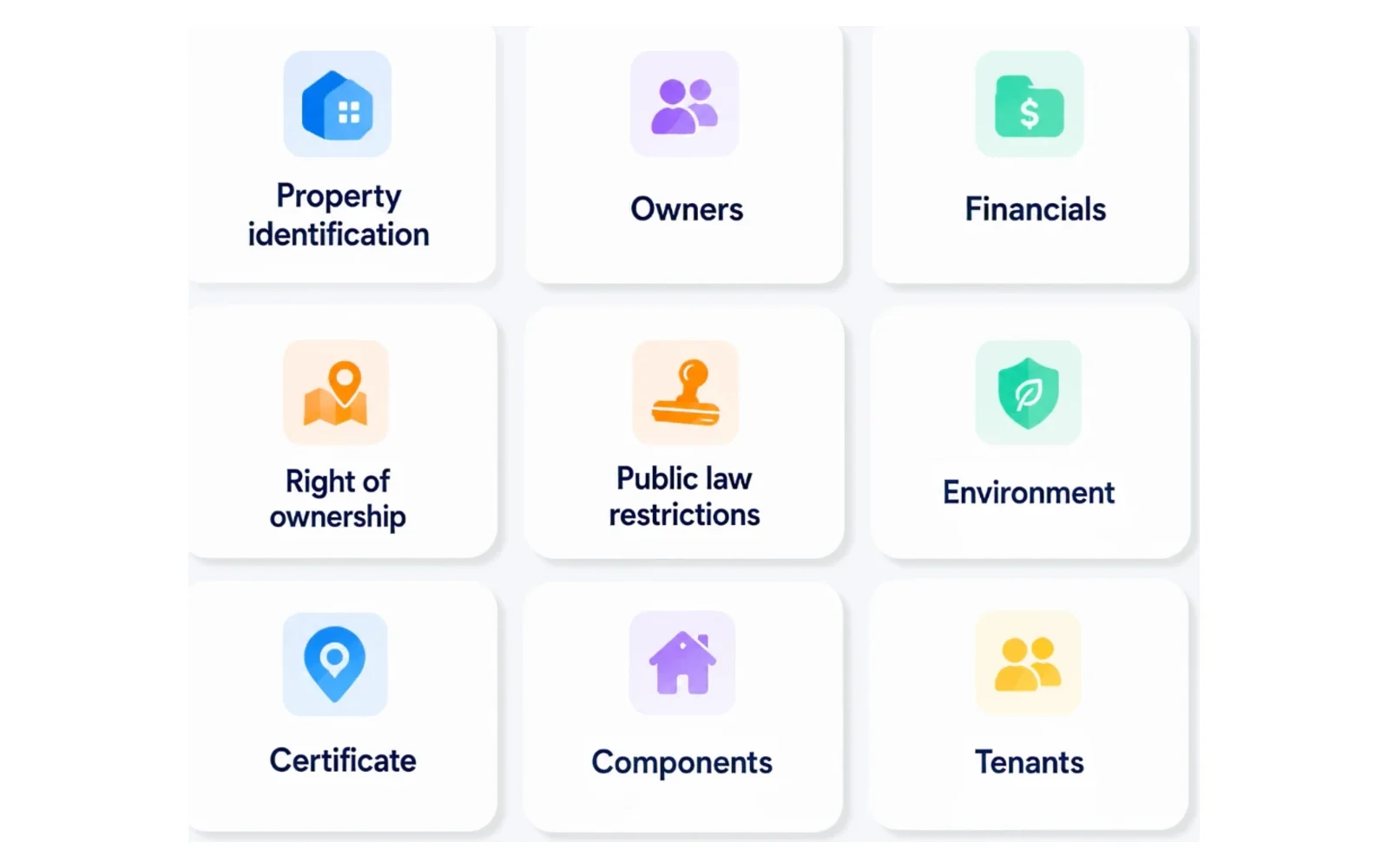
For listing brokers, this creates a practical starting point for reviewing the information associated with a property before publication. Depending on the property and source availability, that overview can include the cadastral lot and land area, building details recorded on the assessment roll, current assessment values, municipal and school taxes, the sales history from the Index of Immovables, published hypothecs and servitudes, environmental map layers, and the certificates of location referred to in registered deeds.
Rather than moving between disconnected sources and documents, brokers can begin with an organized overview of the information available for the property.
The report also identifies certain points requiring attention and indicates when information could not be retrieved, helping distinguish available findings from areas that may warrant additional research. See a sample le topo report. le topo currently covers single-family homes and residential plexes of 2 to 5 units across Québec.
The broker brings the expertise and professional judgment. le topo makes the property information easier to bring together. Source coverage and availability vary, and the broker remains responsible for reviewing the information and determining the appropriate follow-up.
Frequently asked questions
What sources can support land dimensions in a Québec property listing?
Land dimensions and area are commonly documented in the certificate of location, the cadastral plan, and the description in the deed of acquisition, with the unit of measurement indicated. The OACIQ's guidance states that the information in a description sheet must be accurate and verified, and that information the broker cannot verify or document should not be included in it.
Where can the year built be found for a Québec property?
The municipal assessment roll records the year the original construction of the main building was completed, and may note that it is estimated or approximate. The certificate of location may also contain relevant information. The OACIQ cites both documents as supporting documents for the year of construction.
What happens when property information changes after a listing is published?
The OACIQ's guideline states that the duties to verify and inform continue after the description sheet is published: when new relevant information arises, the description sheet is updated. Changes to the seller's declarations are recorded on an Amendments (AM) form signed by the seller. Updating the description sheet and amending the DS form are related but distinct steps.
What does the OACIQ say about ambiguous information in a listing?
The OACIQ's guideline Verification, Information and Advice calls for avoiding ambiguous or imprecise wording that may mislead a party, and cautions against statements such as "to be verified" when a reasonable course of action is possible. Its advertising guideline adds that advertising must be truthful, verifiable, complete, and clear.
Which property documents are commonly associated with a Centris description sheet?
Common sources include the Québec cadastre and Land Register for lot identification and published rights, the municipal assessment roll for assessed values and certain building characteristics, municipal and school tax bills, the certificate of location, municipal zoning by-laws, government environmental maps, and the seller's declarations with their supporting documents.
How can le topo support property research before a Centris listing is published?
le topo brings available property information from covered sources into a structured dashboard and report. This helps Québec listing brokers access relevant records, review supporting information, and organize their property research before publication.
Sources
- OACIQ – Guideline, section 6: Information about the property, main verifications and adverse factors
- OACIQ – Guideline Representation, solicitation, promotion and advertising: Advertising
- OACIQ – Accuracy and verification of information
- OACIQ – Providing accurate and verified information: an obligation (in French)
- OACIQ – Who completes the form Declarations by the seller of the immovable and how can it be amended?
- OACIQ – Summary description of the immovable (Brokerage Contract – Sale)
- OACIQ – Importance of an up-to-date certificate of location
- LégisQuébec – Regulation respecting brokerage requirements, professional conduct of brokers and advertising (CQLR, c. C-73.2, r. 1)
- Centris – Discover Centris
- Centris – How to list my property on Centris.ca (in French)
- Government of Québec – Land Register
- Government of Québec – Québec cadastre
- Government of Québec – Cadastral renewal
- Government of Québec – Property assessment (in French)
- MAMH – The property assessment roll and its content (PDF, in French)
- Government of Québec – Check whether a property is in a flood zone
- Ministère de l'Environnement – Register of contaminated land (in French)